

By Warren Gray
Copyright © 2023
“There are times you know the worst has happened without anyone
telling you. My heart was racing, my palms were beginning to
sweat. I knew my nightmare was beginning again. Only this
time, I was wide awake.”
— Tom Selleck, narrating as Thomas S. Magnum.
The original Magnum, P.I. television crime-drama series aired on CBS from December 1980 to May 1988, starring Tom Selleck as Thomas Sullivan Magnum IV, Private Investigator, who lived on Oahu, Hawaii, on the beachfront estate of wealthy novelist Robin Masters, and famously drove Masters’ red Ferrari 308 GTS.
Ironically, Selleck’s early contract commitment to Magnum, P.I. cost him the starring role in the first Indiana Jones film, Raiders of the Lost Ark, which was released in 1981, starring Harrison Ford instead. Selleck, did, however, win an Emmy Award in 1984 for his superb portrayal of Thomas Magnum in the TV series. Reruns of the entire series have recently been on television where we live.
Three different Ferrari models were used over the course of eight seasons and 162 total episodes. They began with a 1979 Ferrari 308 GTS sports car in Season 1 ($28,600 MSRP at the time), progressing to a 308 GTSi in Seasons 2 through 6, and a 1984 308 GTS QuattroValvole in Seasons 7 and 8. The Ferrari 308 GTS was powered by a 2.9-liter Type F106 AB V8 engine, originally with four Weber 40DCNF carburetors, but with Bosch K-Jetronic fuel injection beginning in 1980, and a five-speed, manual transmission.
European versions produced 252 horsepower, but the American models generated 240 horsepower, due to emissions-control restrictions. Steel bodies contributed to a hefty body weight of 3,230 pounds, and five-spoke, 14-inch, alloy wheels (16- inches from 1984 onward) were standard, with Michelin TRX radial tires. The fuel-injected, 1981 GTSi models had only 205 horsepower (211 HP in Europe), but the newer, 308 GTS QuattroValvole models used F106 BB double-overhead-cam, 32-valve cylinder heads, boosting power back up to 240 horses in Europe, and 230 HP in America. This resulted in 0-to-60 mph acceleration times of 6.7 seconds (QuattroValvole) to 7.9 seconds (GTS), covering a quarter-mile in 15.0 seconds (QuattroValvole) to 16.0 seconds (GTS).
It’s interesting to note how things change over time. Today, I drive a fairly ordinary, dark-gray, Subaru Forester XT family SUV with 260 horsepower (250 HP stock), a turbocharged, double-overhead-cam engine, and 18-inch wheels, weighing 400 pounds more than Magnum’s Ferrari, and actually more powerful. It’s also a half-second faster, at 0 to 60 in 6.2 seconds, and 14.8 seconds in the quarter-mile, but it just doesn’t have those flashy, eye-catching Ferrari looks.
Way back in 1979 and 1980, however, I was driving a tiny, white Fiat X1/9, which looked a lot like a mini-Ferrari, especially with an Ansa quad exhaust system, but only produced 72 horsepower (67 HP stock) and cost me a mere $2,000 used. It ran 0-to- 60 mph in 10.5 seconds and was an absolute blast to drive! So, speed, style, and performance are all relative, and our concepts of each have changed over time.
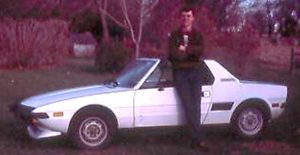
Author with his low-slung, Fiat X1/9 sports car in 1980. Photo by author
Thomas Magnum’s character was an ex-Navy SEAL officer, with combat experience in Vietnam, the son of a Korean War fighter pilot who was killed in action, and Thomas sometimes wore his father’s Rolex GMT Master wristwatch. His wartime medals included the Navy Cross for heroism, and the Purple Heart for his wounds. His primary handgun was a Colt MK IV/Series 70 Government Model, a commercial version of the military M1911A1, supposedly representing the handgun that he carried in Vietnam.
The original gun used in the series was in .45 ACP, but because blanks in that caliber were too difficult to obtain, it was soon changed to a 9mm version, but was still referred to as a “forty-five” for the show. Magnum usually tucked it inside his waistband, with no holster, but sometimes wore it in a brown, leather, military shoulder holster.
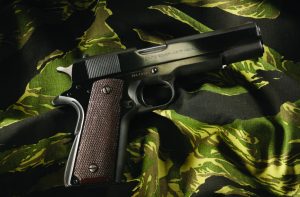
The actual 1983 Colt main prop gun from
Magnum, P.I., serial number 70L33101.
Photo credit: National Firearms Museum
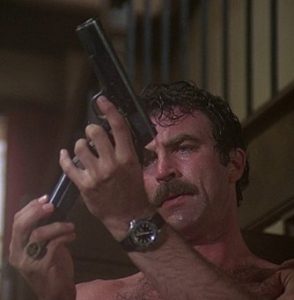
Magnum loads his Colt Government Model in Season 1,
with Chronosport Sea Quartz 30 waterproof dive watch.
Photo credit: imfdb.org
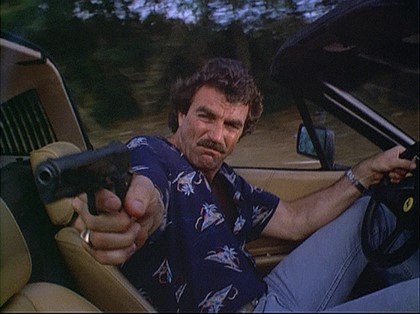
Magnum uses his Colt Government Model in Season 4. Photo credit: imfdb.org
Photo credit: imfdb.org
Late in Season 3, Magnum carried a Walther PPK pistol in 7.65x17mm (.32 ACP) in an ankle holster as a backup weapon, and in Season 4, he used a more-powerful, Detonics Pocket 9 in 9x19mm as a backup weapon in one episode.
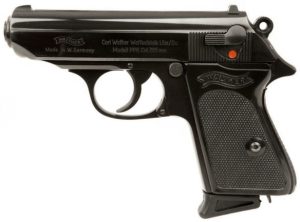
Magnum holding Walther PPK.
Photo credit: imfdb.org
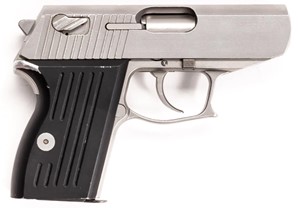
Detonics Pocket 9. Photo by Guns.com
Moving on to submachine guns, Thomas Magnum used a fully-automatic 9mm Uzi once in Season 4, again in Season 8, and in Season 5, he fired a modified HK94 (an MP5 derivative) during a wild adventure in Cambodia. The barrel was chopped from 16.54 inches to 8.9 inches, and the civilian carbine was converted to resemble an H&K MP5A3 weapon.
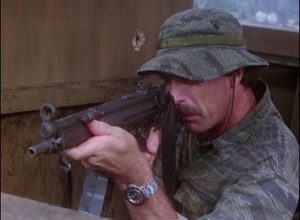
Magnum in Cambodia, with HK94 submachine gun.
Photo credit: imfdb.org
When it comes to rifles, Magnum was occasionally seen in flashbacks to the Vietnam War using an M16A1 assault rifle with 20-inch barrel in action, although genuine Navy SEALs in Vietnam definitely preferred the excellent, Stoner 63A Commando carbine with 15.7-inch barrel. U.S. Army Special Forces favored the Colt CAR-15 or XM177E1/E2 carbine with 10-inch, 10.5-inch, or 11.5-inch barrel.
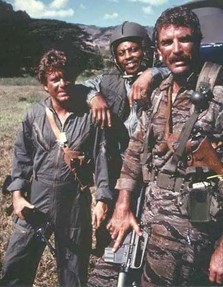
Magnum with fellow team members Rick and T.C. in Vietnam,
with Colt MK IV/Series 70 pistols and M16A1 rifles.
Photo credit: pinterest.com
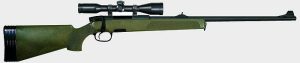
Steyr SSG 69 PI sniper rifle.
Photo credit: Steyr Mannlicher, CC BY 2.0, via Wikimedia Commons
Late in Season 8, Thomas Magnum uses a Steyr SSG 69 PI sniper rifle in .308-caliber, with an improvised suppressor, to hunt down Quang Ki, the North Vietnamese intelligence officer who killed Magnum’s French-Eurasian ex-wife, Michelle, and her third husband, and tried to kill Magnum’s young daughter, Lily Catherine, tracking Ki to a remote island in French Polynesia. There, Ki is being secretly exchanged by the U.S. government for an American prisoner of war illegally detained in Cambodia for the past 18 years. Although Magnum has Ki squarely in the crosshairs of his rifle scope, he reluctantly decides not to take the shot, in the interest of preserving positive relations between the U.S. and Vietnam, in order to possibly free more POWs in the future.
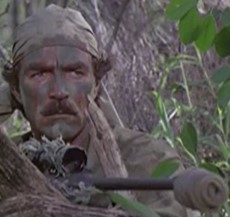
Photo credit: magnumpi.fandom.com/wiki/Unfinished_Business
In April 2018, the 11,000-square-foot, 1933 Spanish Colonial-style mansion on the three-acre, seaside estate used for filming much of the Magnum, P.I. series was demolished, marking the end of an era for the property, which had been used for hundreds of years to raise sea turtles for the Hawaiian royal family. My wife and I stopped at the front gate to the estate in April 2016, but it was private property, closed to the public.
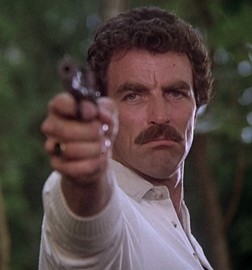
Magnum raises his Colt in Season 3 to kill ruthless,
Russian officer and assassin, “Ivan.”
Photo credit: imfdb.org
By comparison, in the 2018 reboot of the famous TV series, Jay Hernandez plays the part of Magnum, without the trademark moustache, also a former Navy SEAL officer, and he drives a red Ferrari 488 Spider (0-to-60 in 3.0 seconds flat!) with a twin-turbocharged, V8 engine. Magnum’s preferred sidearm is an STI Costa Carry Comp in .45 ACP. The new series, however, does not have the same overwhelming popularity or flair as Tom Selleck’s version, and is officially ending soon, after just five seasons.
This has been a brief look at the various guns and flashy, red Ferraris used in the filming of the original Magnum, P.I. series from 1980 to 1988. Even now, 35 years after the show ended, it still captures our imagination due to the great acting, tropical settings, patriotism, fast cars, sense of humor, and timeless characterization of a strong, humble, charismatic, and heroic figure of an action star.
* * *
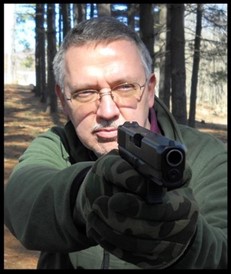
Author with Glock-30 in .45 ACP.
Photo by Dan Gray
Warren Gray is a retired, U.S. Air Force intelligence officer with experience in joint special operations and counterterrorism, and is an NRA member. He served in Europe and the Middle East, earned Air Force and Navy parachutist wings, four college degrees, and was a distinguished graduate of the Air Force Intelligence Operations Specialist Course, and the USAF Combat Targeting School. He is currently a published author, historian, sports car enthusiast, and hunter.